Quarto-Powered Executable Reports¶
Status: draft Date: 2026-04-18
1. Problem¶
Deliverables spec defines three artifact types: reports, presentations, posters. Presentations are now presentio section trees; posters are still a manual markdown convention; reports currently sit in an awkward middle state.
A report is an aggregate: it pulls together questio question state, notio result notes, figio figures, and pipeio flow status into a single document for an external audience (supervisor, lab meeting, funder). Today:
questio-reportskill generates static markdown- The markdown is stale the moment a pipeline reruns or a result note is added
- Rebuilding means re-running the skill and hoping the LLM does the same thing
- Figures are embedded by path (brittle) or omitted (common)
Every property a good report should have — re-executes against current state, caches what's unchanged, embeds live notebook outputs, respects the pandoc bibliography chain — lines up with what Quarto already does. This spec introduces a Quarto backend for the reports layer only. Presentations, posters, manuscripts, result notes, and notebooks are out of scope.
2. Design Principles¶
- Reports are reactive, notes are atomic. Reports re-execute on build; result notes stay pure markdown. The two layers are deliberately different tools.
- Reports carry preliminary figures, not composed ones. A report sits one level below the manuscript layer. Its figures are raw notebook outputs — useful for showing work in progress to a supervisor or lab meeting, not publication-ready. Figio's composition model (panel layout, SVG assembly, PDF export) is deliberately out of the report path — figio targets manuscripts and decks, where figures have matured into final form.
- Quarto is a backend, not a takeover. Projio's existing render chain (pandoc + CSL via
.projio/render.yml) still owns manuscripts, decks, and prose pages. Quarto runs only insidedocs/deliverables/reports/. - Embed, don't re-execute. A report references executed pipeio notebooks via Quarto's
embedshortcode. The notebook was already executed bypipeio_nb_exec; the report just pulls the labeled cell. No duplicate computation. - Runner-aware. Quarto must render inside the project's compute environment (conda or pixi) so embedded Python/R chunks resolve the same way as pipeio.
- Graceful degradation. Projects without Quarto installed can still author
.mdreports.report_buildreports "quarto not available; runpip install quarto-cli" instead of silently failing. - Deliverables-native. Reports live at
docs/deliverables/reports/<name>/, matching the<name>/subdirectory pattern decks use. No surprising new location.
3. Directory Layout¶
docs/deliverables/
  reports/
    index.md                             # auto-generated report list (questio_docs_collect)
    <name>/                              # one directory per report
      report.qmd                         # Quarto source (executable)
      _quarto.yml                        # per-report Quarto config (optional override)
      _freeze/                           # Quarto's execution cache (gitignored)
      _files/                            # Quarto's generated assets (gitignored)
      build/
        report.html                      # primary output
        report.pdf                       # optional (quarto render --to pdf)
Report-level _quarto.yml is optional. A project-level .projio/render/quarto.yml supplies defaults (bibliography, CSL, theme, execution engine) that each report inherits.
Single-file reports (report.qmd without a subdirectory) are allowed but discouraged — the subdirectory gives Quarto's _freeze/ and _files/ a home without polluting docs/deliverables/reports/.
4. Frontmatter Schema¶
Quarto uses YAML frontmatter natively. Projio adds four fields on top of Quarto's own schema:
---
title: "Weekly Progress Report — Week of 2026-04-14"
author: "Arash Shahidi"
date: 2026-04-19
format:
  html:
    toc: true
    code-fold: true
    theme: cosmo
  pdf:
    documentclass: article
bibliography: "../../../.projio/render/compiled.bib"  # inherits from render.yml
csl: "../../../.projio/render/csl/apa.csl"

# projio-specific fields (read by report_build and questio_docs_collect)
type: report
audience: supervisor             # supervisor | team | conference | public
period: "2026-04-14 to 2026-04-19"
questions: [q-swr-detection, q-spindle-density-age]
results: [result-arash-20260415-..., result-arash-20260417-...]
source_flows: [preprocess_ieeg, detect_swr]
---
The bibliography and CSL paths resolve via the existing projio render chain — same compiled.bib that manuscripts and decks use, so citations are consistent across all deliverable types.
5. Figure sources¶
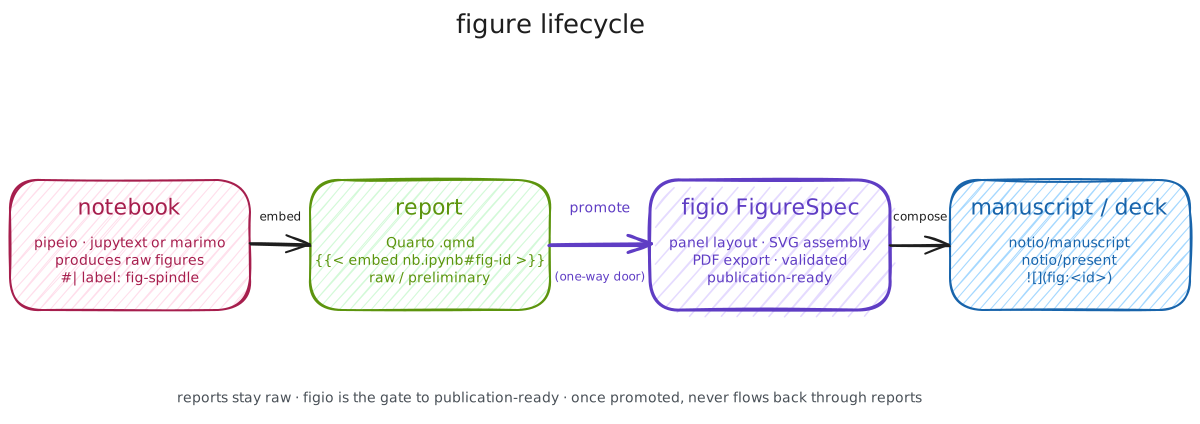
The notebook is the figure source for reports. A report reaches directly into an executed pipeio notebook for its plots — these are working figures, not composed ones. If a particular figure later matures to publication quality, it gets promoted to a FigureSpec under figio and enters the manuscript/deck path instead; it does not continue to flow through reports.
Two mechanisms are supported — one primary, one fallback — chosen by notebook backend:
| Source | Mechanism | When to use |
|---|---|---|
| Primary | Quarto {{< embed >}} shortcode referencing a labeled cell |
jupytext percent-format or native .ipynb notebooks executed via pipeio_nb_exec |
| Fallback |  pointing to a file written by pipeio_nb_extract |
marimo notebooks; ad-hoc analyses without a pipeio flow; notebooks that no longer execute |
Design choices rejected (recorded here so future contributors don't re-open them):
- In-report regeneration (Quarto code chunks that re-run the analysis inside the report): rejected. Duplicates analysis logic across the notebook and the report; violates the delegation model ("no subsystem embeds content it doesn't own"). A report regenerating a figure is the report doing pipeio's job.
- Dedicated report notebook (a separate notebook per report containing only narrative figures): rejected. Adds a new artifact type without solving duplication — data loading and preprocessing inevitably get copied from the analysis notebook. Gives no advantage over primary embed once analysis cells are labeled.
5a. Primary: Quarto embed¶
Quarto's embed shortcode is the main path. A report embeds a labeled cell from an executed notebook:
## Spindle density declines with age

{{< embed ../../../code/pipelines/detect_swr/notebooks/spindle-analysis.ipynb#fig-spindle-density-age >}}

Across N=18 subjects, we observed a significant negative correlation
(r=-0.42, p=0.003) between subject age and per-minute spindle count
during NREM sleep.
Requirements:
- Notebook must be jupytext percent-format or native .ipynb
- Notebook must have been executed (pipeio_nb_exec) so cached outputs live in the .ipynb JSON
- Cell must be labeled: #| label: fig-spindle-density-age in the code chunk header
- Optional caption override: {{< embed nb.ipynb#fig-id caption="..." >}}
Re-rendering the report is cheap — Quarto pulls the cached cell output without re-executing. Freshness is tied to when pipeio_nb_exec last ran the notebook, which is the correct coupling.
5b. Fallback: exported figure files¶
For notebooks that Quarto cannot embed (primarily marimo), pipeio_nb_extract extracts figures by cell label to PNG/SVG files. The report references these directly:

This path loses the single-source-of-truth property (the figure file can drift from notebook code) but preserves report portability: a six-month-old report still renders even if the notebook is gone.
5c. report_build validation¶
report_build parses the .qmd for both embed shortcodes and image references, then validates preconditions before invoking quarto render:
- Embed targets: notebook file exists, is
.ipynb, is executed, cell label resolves - Image refs under
figures/: file exists - Bibliography resolves if the report body contains at least one citation (
@citekey); a report with no citations builds cleanly even whenbibliography:points at a non-existent file - Missing preconditions reported up-front with actionable errors rather than surfacing Quarto's own failure modes
6. report_build MCP tool¶
New tool in src/projio/mcp/report.py, registered in server.py:
report_build(name: str, format: str = "html") -> JsonDict
Execution chain:
1. Resolve docs/deliverables/reports/<name>/report.qmd (or flat .qmd)
2. Validate: file exists, frontmatter parses, bibliography path resolves
3. Detect runner via .projio/config.yml code.runner — pixi or conda
4. Invoke quarto render report.qmd --to <format> inside the project's compute env:
- pixi: pixi run [-e <env>] quarto render ...
- conda: conda run -n <env> quarto render ...
5. Read build/report.<ext> metadata, return path + render log
Additional tools (phase 2):
- report_list() — enumerate docs/deliverables/reports/*/report.qmd
- report_status(name) — staleness check (report mtime vs. source notebooks, result notes, figio outputs)
- report_init(name, template) — scaffold a new report with questio/result preamble filled in from current state
- report_validate(name) — dry-run preflight without quarto render
Phase 1 ships only report_build + report_init.
7. Relationship to existing layers¶
questio_status       ──→  report.qmd  (question + hypothesis state, templated on init)
result notes         ──→  report.qmd  (cite via @result-id or embed verbatim)
pipeio notebooks     ──→  report.qmd  ({{< embed nb.ipynb#fig-id >}})
biblio (compiled.bib)──→  report.qmd  (bibliography: inherits from render.yml)

report.qmd           ───  docs/deliverables/reports/<name>/build/report.html
Figio is deliberately absent from the report path. Figio composes notebook outputs into publication-ready figures for manuscripts and decks — that is one layer above reports. A figure's lifecycle is: (1) produced by a pipeio notebook, (2) embedded raw in reports while exploratory, (3) promoted to a FigureSpec under figio once it matures, (4) carried into manuscripts and decks from there. Reports never consume figio outputs; promotion is a one-way door.
Reports reference upstream objects (questions, results, flows) via frontmatter exactly like the existing deliverables schema. No new linking direction.
8. Runner integration¶
The existing code.runner resolution (conda | pixi, auto-detected from pixi.toml) extends to Quarto:
# .projio/config.yml
code:
  runner: pixi
  envs:
    default: ""            # pixi default env
    report: ""             # optional override for quarto execution
Resolution chain for the quarto binary:
1. code.envs.report if set → <runner> run [-e <env>] quarto
2. code.envs.default if set → same
3. quarto on PATH → bare invocation
4. Error: "quarto not found — install with pip install quarto-cli or add to project env"
This matches the existing snakemake resolution chain in pipeio — same mental model, no new config surface.
9. Skills integration¶
One new skill plus an evolution of an existing one.
New skill: report-build (src/projio/data/skills/report-build/SKILL.md)
- Triggered by "write a progress report", "generate a supervisor update"
- Workflow:
1. questio_status() to gather current question state
2. note_list(type="result", since=<period>) to collect recent results
3. pipeio_flow_status() for flow-level state
4. report_init(name, template=<progress|update|milestone>) — scaffolds report.qmd with preamble filled in
5. Agent drafts prose in the body; uses {{< embed >}} for notebook figures
6. report_build(name) to render
Evolved skill: questio-report gains a --format quarto mode that emits report.qmd instead of static .md. Existing markdown behavior preserved for back-compat and for projects without Quarto installed.
10. Out of scope¶
Explicitly not addressed by this spec: - Result notes. Stay pure markdown. Figure embedding in result notes is a separate pipeio/figio wiring concern, tracked separately. - Figio. Reports do not consume figio outputs; figio remains focused on composing publication-ready figures for manuscripts and decks. - Manuscripts. Pandoc + projio's existing render chain remain the manuscript backend. Quarto's journal templates could be a separate manuscripto spec later. - Decks. Presentio has its own spec and its own backends (Marp, revealjs via pandoc). - Docs site. MkDocs Material stays. - In-report figure regeneration. Reports never re-run analysis code; figures come from labeled notebook cells (primary) or exported files (fallback). See §5.
11. Migration path¶
For existing projects (e.g., pixecog) with ad-hoc reports:
1. projio sync writes .projio/render/quarto.yml defaults if missing
2. Existing .md reports under docs/deliverables/reports/ keep working
3. New reports scaffold as .qmd via report_init
4. No forced migration — reports can be rewritten to .qmd as they're touched
12. Design decisions (resolved)¶
12a. Quarto version pin → runtime check, min-version in project config¶
Decision: report_build runs a runtime quarto --version check against a minimum declared in .projio/render/quarto.yml. No pyproject optional-dependency on quarto-cli.
Rationale: quarto-cli on PyPI is a thin wrapper around the actual Quarto binary; most users install via homebrew, apt, nix, pixi, or direct download. A pyproject optional-dep is the wrong install channel — users who already have quarto don't appreciate pip "installing" a duplicate, and users who want the official installer don't get value from the pyproject declaration. A runtime check is the thing that actually matters: it catches stale installs and gives a specific, actionable error.
# .projio/render/quarto.yml
min_version: "1.5"
report_build caches the version probe in-process so subsequent builds in the same MCP session don't re-shell-out. Error surface:
quarto ≥ 1.5 required; found 1.3.450.
Install: https://quarto.org/docs/get-started/
12b. Cross-project embeds → phase 2, shape sketched¶
Decision: Deferred to phase 2. Not blocking phase 1. Shape of the answer:
- New tools:
report_import_notebook(name, from_project, rel_path)andreport_refresh_import/report_freeze_import, mirroring presentio's import trio - Fetch an executed
.ipynbfrom another project viaworklog_read_file - Cache at
docs/deliverables/reports/<name>/imports/<project>-<hash>.ipynb - Sidecar provenance:
imports/<project>-<hash>.ipynb.import.yamlwithimported_from_project,imported_from_commit,import_mode: reference | freeze,imported_at - Report embeds cells via
{{< embed imports/<project>-<hash>.ipynb#fig-id >}}
Why this works: Quarto's embed only needs the executed .ipynb JSON with cached outputs — no re-execution in the host project. The source project already ran the notebook; the host is just pulling cell outputs. Host compute environment is irrelevant for the embed path.
What to watch before phase 2 lands: cache invalidation policy (what triggers a refresh?), cross-project bibliography resolution (cited keys in the embedded cell may not resolve in the host's bib), and figure caption/numbering across embedded cells.
12c. _freeze/ → gitignored by default¶
Decision: _freeze/ and _files/ are added to .gitignore by projio sync under the # >>> projio >>> managed block. No DataLad annex by default. Users who want durable caches (rare) can negate the ignore per-project.
Rationale: Projio reports embed from already-executed pipeio notebooks — {{< embed >}} pulls cached cell outputs from the source .ipynb, it does not re-execute. That means Quarto's _freeze/ for a projio report mostly caches final HTML assembly, not analysis computation. It's pure performance — small, regenerable in seconds, not load-bearing. The DataLad annex overhead and the symlink-to-cache dance aren't worth it for this use case. Keep it simple.
# >>> projio >>>
# ...existing entries...
docs/deliverables/reports/*/_freeze/
docs/deliverables/reports/*/_files/
# <<< projio <<<